Book Appointment Now

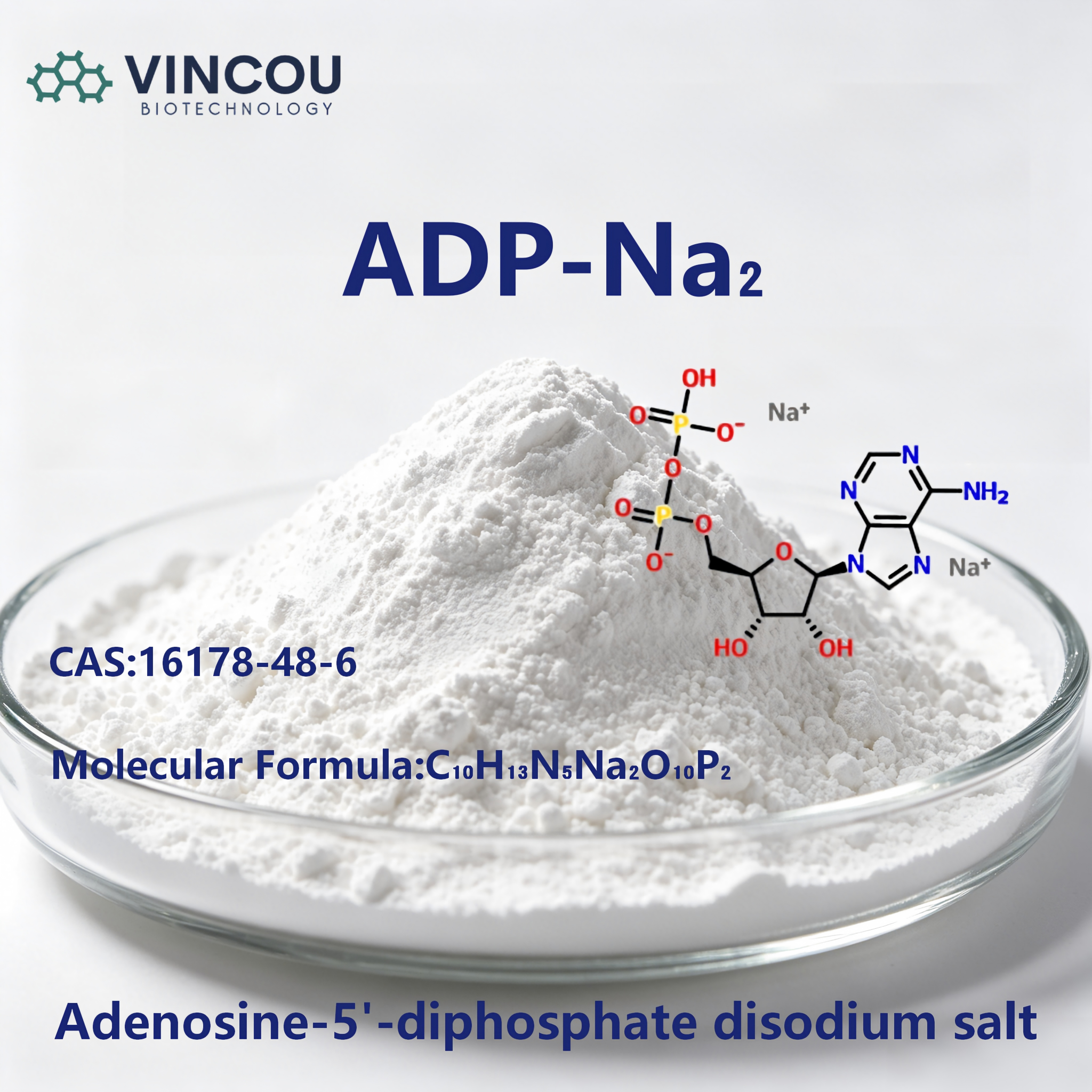
ADP-Na₂ CAS:16178-48-6
We manufacture premium Adenosine 5′-Diphosphate Disodium Salt (ADP Na2, CAS 16178-48-6), white hygroscopic crystalline nucleotide powder. Two standard grades: biochemistry reagent grade ≥99% HPLC and pharmaceutical intermediate grade ≥98% HPLC. Widely used as platelet aggregation inducer for clinical diagnostic test kits, ATP synthesis raw material, and enzymatic assay substrate for molecular lab research. Strict ion exchange purification, full third-party testing, flexible packaging 1g-25kg, free lab samples for global biotech, diagnostic and pharma manufacturers.
Direct Factory Supply
Adenosine 5′-Diphosphate (ADP) Disodium Salt
Premium Bulk Factory Stock with Custom Moisture Control Packaging and Reliable Global Cold Chain Shipment.
Chemical Identity & Identification
Registry Identifiers
CAS Number: 16178-48-6
EINECS Number: 240-314-7
Molecular Mass
Anhydrous MW: 471.16 g/mol
Optimized for precise batch formulation
Impurity Thresholds
ATP & AMP Limit: <0.5% (HPLC)
Heavy Metals: Low heavy metal control
Available B2B Commercial Purity Grades
| Application Grade | Purity Standard | Best Suited For |
|---|---|---|
| Bioresearch Grade | ≥99.0% | In-vitro diagnostic kits & enzymatic assays |
| Pharma Intermediate Grade | ≥98.0% | Nucleotide therapeutic drug large-scale synthesis |
Complete Compliance & Quality Records
Every production batch undergoes strict QA/QC validation. The following original documentation is fully available for regulatory factory audits and customs clearance:
📄 COA (Certificate of Analysis)
🛡️ MSDS (Safety Data Sheet)
📊 HPLC Chromatogram Spectrum
🧬 Endotoxin Testing Report
🛡️ MSDS (Safety Data Sheet)
📊 HPLC Chromatogram Spectrum
🧬 Endotoxin Testing Report
Target Application Scenarios
🔬 Platelet Function Test Kits (IVD Raw Material)
Acts as the standard agonist inducer for platelet aggregation tests with zero false-positive interference, perfectly matching international diagnostic manufacturing criteria.
💊 Nucleotide Drug Synthesis (Pharma Intermediates)
An ideal structural block for mass manufacturing ATP disodium derivatives, cAMP regulators, and continuous therapeutic drug pipelines.
Product Specs
1. Full Chemical Identification Data
| Item | Standard Parameter |
|---|---|
| Full Chemical Name | Adenosine 5′-Diphosphate Disodium Salt |
| Common Aliases | ADP Disodium Salt, ADP Na2, Disodium 5′-ADP |
| CAS Registry Number | 16178-48-6 (anhydrous) |
| EINECS Number | 240-314-7 |
| Molecular Formula | Anhydrous: C₁₀H₁₃N₅Na₂O₁₀P₂ (471.16 g/mol) Dihydrate: C₁₀H₁₃N₅Na₂O₁₀P₂·2H₂O (507.17 g/mol) |
| HS Customs Code | 2934999090 |
| Optical Rotation | [α]₂₀/D -29.6° (0.5M phosphate buffer) |
| UV Spectrum Data | λmax = 260nm, ε₂₆₀ = 15400 M⁻¹·cm⁻¹ (in pH7 PBS) A250/A260 = 0.74~0.82; A280/A260 = 0.13~0.19 |
2. Physicochemical Properties
Appearance & pH
White to off-white odorless crystalline powder. 1% Aqueous Solution pH stands at 7.0–8.5 (weak alkaline).
White to off-white odorless crystalline powder. 1% Aqueous Solution pH stands at 7.0–8.5 (weak alkaline).
⚠️ Hygroscopy & Stability
Highly hygroscopic, must be sealed immediately after opening. Thermal Stability: Decomposes above 120°C (no clear melting point).
Highly hygroscopic, must be sealed immediately after opening. Thermal Stability: Decomposes above 120°C (no clear melting point).
Solubility & Restrictions
Freely soluble in purified water; slightly soluble in methanol; insoluble in organic solvents like ethanol, acetone, ether. Avoid strong acids, oxidants, and heavy metal ions.
Freely soluble in purified water; slightly soluble in methanol; insoluble in organic solvents like ethanol, acetone, ether. Avoid strong acids, oxidants, and heavy metal ions.
3. B2B Quality Control Standard Index
🔬 Grade 1: Biochemical Reagent Grade
Best for Lab Research & Diagnostic Kit Raw Materials
- Main Content (HPLC, dry basis): ≥99.0%
- Water Content (Karl Fischer): ≤7.0%
- ATP Impurity / Endotoxin: ≤0.5% / <0.1 EU/mg
- AMP + Adenosine Total Impurity: ≤0.3%
- Heavy Metals (Pb) / Arsenic: ≤10 ppm / ≤2 ppm
- Chloride / Sulfate: ≤0.1% / ≤0.1%
- Microbial Limit: Aerobic ≤10 CFU/g; Mold & Yeast ≤1 CFU/g
🏭 Grade 2: Pharmaceutical Intermediate Grade
Optimized for Bulk Drug Synthesis Raw Materials
- Main Content (HPLC, dry basis): ≥98.0%
- Water Content (Karl Fischer): ≤8.0%
- ATP Impurity / Endotoxin: ≤1.0% / <0.5 EU/mg
- AMP + Adenosine Total Impurity: ≤0.8%
- Heavy Metals (Pb) / Arsenic: ≤20 ppm / ≤3 ppm
- Total Aerobic Microbe: ≤100 CFU/g
4. Verified Manufacturing Process
⚙️ Advanced Enzymatic Phosphorylation Line
Our ADP disodium salt adopts a professional enzymatic phosphorylation + ion exchange purification production line, run in fully independent factory workshops. High-purity AMP undergoes a highly controlled pyrophosphorylation reaction. The crude liquid passes through strong acid/alkaline ion-exchange resins for complete desalting and impurity separation, followed by low-temperature vacuum recrystallization and nitrogen-filled vacuum drying to minimize moisture and degradation risk. The consistent batch-to-batch stability perfectly supports mass diagnostic reagent production and continuous pharma synthesis.
5. Downstream Application Scenarios
🧬 Clinical Diagnostic Reagent Manufacturing
Core raw material for platelet aggregation test kits; acts as a standard agonist to detect platelet P2Y12 receptor activity for thrombosis screening, cardiovascular disease auxiliary diagnosis kits, and CK/CK-MB biochemical detection substrates.
💊 Pharmaceutical Intermediate Production
Synthesis precursor for ATP disodium injection, cyclic AMP (cAMP), and purine signaling pathway targeted therapeutic drugs; key raw material for energy metabolism regulating medicine R&D.
🔬 Molecular Biology & Biochemical Lab Research
Standard substrate for ATPase, adenosine kinase, and phosphoryl transferase enzyme kinetic experiments; extensively used in cellular mitochondrial energy metabolism and purine receptor signal transduction academic research.
🧪 Biotech Fermentation Industry
Utilized as a functional coenzyme additive for microbial fermentation to accelerate intracellular ATP circulation and effectively improve overall fermentation yields.
6. Packaging Specifications & Shipping Terms
- Flexible Package Sizes: Small Sample Package (1g, 5g, 10g, 50g, 100g nitrogen vacuum aluminum foil bags) & Bulk Industrial Package (1kg inner vacuum aluminum bag + outer fiber drum; 25kg sealed fiber drum).
- Custom Options: Sterile medical-grade vacuum bags, 5kg/10kg mid-bulk options available upon request.
- Shipping Condition: Non-dangerous chemical goods. Supports global air and sea freight. Shipped in cool, dark, and moisture-proof packaging.
- Shelf Life: 18 months under -20℃ sealed storage; valid for 3 months after opening when stored at 2–8℃.
7. Why Source From Us? Factory Supply Advantages
✓ 10 Tons Monthly Capacity
Real nucleotide manufacturer ensuring reliable, long-term bulk stock supply without middleman markup.
Real nucleotide manufacturer ensuring reliable, long-term bulk stock supply without middleman markup.
✓ Custom Parameter Flexibility
Tailored purity, moisture, and endotoxin indicator matching based on your diagnostic kit or pharma formula demand.
Tailored purity, moisture, and endotoxin indicator matching based on your diagnostic kit or pharma formula demand.
✓ 1-5g Free Lab Samples
Evaluate quality risk-free. All trial samples are shipped with matching batch formal COA testing reports.
Evaluate quality risk-free. All trial samples are shipped with matching batch formal COA testing reports.
✓ Full Export Document Suite
Experienced export support including MSDS, custom declaration paperwork, and optional third-party SGS testing.
Experienced export support including MSDS, custom declaration paperwork, and optional third-party SGS testing.
FAQ
1: Product Specifications & Identity
❓ Q1: What is the difference between ADP disodium salt anhydrous and dihydrate?
A: Anhydrous ADP Na2 has lower moisture content (<7%), making it highly stable for diagnostic kit formulation and high-precision laboratory assays. Dihydrate ADP disodium contains fixed crystal water and is mainly used as a pharmaceutical synthesis intermediate with a wider water content tolerance. Clients can select based on downstream production formula requirements; we fully support custom dehydration processes per demand.
❓ Q2: Why is ADP disodium salt the standard inducer for platelet aggregation test kits?
A: ADP specifically binds to platelet P2Y12 purine receptors to trigger platelet activation and aggregation reactions, offering stable binding efficiency and low impurity interference. Our 99% reagent grade features ultra-low ATP residual, which successfully avoids false-positive test results in clinical platelet function detection kits, fully matching international diagnostic reagent manufacturing standards.
2: Customization & Bulk Application
❓ Q3: What MOQ do you offer for diagnostic reagent factory bulk orders?
A: Our minimum order quantity is 1kg for industrial grade; laboratory trial sample orders accept 1g–100g small quantities. Our monthly production capacity reaches 10 tons, easily supporting continuous large-scale bulk orders for global diagnostic kit manufacturers and pharmaceutical intermediate factories.
❓ Q4: Can you customize low-endotoxin ADP disodium salt for injectable drug intermediate production?
A: Yes, we have a dedicated sterile purification workshop to produce low-endotoxin grade ADP Na2 with endotoxin <0.05 EU/mg and strictly controlled microbial counts. This grade is fully compliant with injectable raw material production standards for nucleotide drug synthesis.
3: Storage, Logistics & Compliance
❓ Q5: What storage rules should lab and production factories follow to prevent ADP degradation?
A: ADP disodium salt is highly hygroscopic and sensitive to temperature and light. It requires sealed nitrogen-filled storage at -20℃ for long-term preservation; short-term working stocks can be stored in a 2–8℃ refrigerator with a desiccant. Avoid repeatedly opening the package, as exposure to air will cause fast hydrolysis into AMP and ATP impurities, damaging downstream reagent stability.
❓ Q6: What documents can you provide for customs clearance and factory quality audit?
A: We supply a full set of export certifications: COA, MSDS, HPLC chromatogram, UV absorption spectrum, heavy metal & endotoxin test reports, factory production workshop audit records, and SGS third-party testing certificates upon client request.
❓ Q7: How long is the lead time for mass bulk shipment?
A: Standard stock goods require 3–5 working days for delivery after deposit confirmation; customized special purity or low endotoxin grades require 7–10 working days of production lead time. We arrange cold-chain moisture-proof packaging before shipment to guarantee product quality during transport.
❓ Q8: Is ADP disodium salt classified as dangerous goods for international shipping?
A: No, ADP disodium salt is classified as an ordinary, non-hazardous biochemical fine chemical, without any dangerous goods transportation restrictions. We provide complete non-dangerous certification for seamless customs clearance in the EU, USA, Southeast Asia, and other global regions.
Certificate
COA, MSDS, and GMP PDF files are available for download.
Ensure quality compliance for pharmaceutical, biotechnology, and cosmetic applications.
ADP Disodium Salt CAS 16178-48-6 Complete Guide for Diagnostic Kit & Pharmaceutical Raw Material Buyers
1. What Is Adenosine 5′-Diphosphate Disodium Salt & Its Core Biochemical Functions
Adenosine 5′-Diphosphate Disodium Salt, widely shortened as ADP Na2 or ADP disodium salt, is a critical purine nucleotide compound marked with CAS number 16178-48-6, occupying an irreplaceable position in cellular energy circulation and purine signal transduction pathways. Structurally, the molecule combines an adenosine base with two linked phosphate groups and two sodium ions, forming a highly water-soluble crystalline powder suitable for aqueous biochemical reactions.
🔬 Biochemical Mechanism Perspective:
ADP Na2 acts as the core intermediate of the ATP-ADP energy cycle inside all eukaryotic cells. When cells consume energy, ATP releases one phosphate group and converts into ADP; under ATP synthase catalysis, ADP combines free phosphate to regenerate energy-storing ATP again. This reversible cycle makes high-purity ADP disodium an essential substrate for all enzymatic assays related to energy metabolism research.
ADP Na2 acts as the core intermediate of the ATP-ADP energy cycle inside all eukaryotic cells. When cells consume energy, ATP releases one phosphate group and converts into ADP; under ATP synthase catalysis, ADP combines free phosphate to regenerate energy-storing ATP again. This reversible cycle makes high-purity ADP disodium an essential substrate for all enzymatic assays related to energy metabolism research.
For B2B industrial buyers including diagnostic reagent manufacturers, biotech labs, and pharmaceutical intermediate plants, the sodium salt form brings obvious advantages over free ADP acid: neutral aqueous solution pH, stable long-term storage, no strong acid corrosion risk during reagent formulation, and uniform dissolution without undissolved precipitates in clinical test buffer systems. The two mainstream product forms, anhydrous and dihydrate ADP disodium, cater to different downstream production demands.
2. Key Industrial Applications of High Purity ADP Disodium Salt for Global Manufacturers
IVD Reagent Raw Material for Clinical Platelet Aggregation Diagnostic Test Kits
The largest commercial consumption scenario of ADP disodium salt lies in in-vitro diagnostic kit production. As the gold-standard platelet activation inducer, ADP specifically targets platelet P2Y12 receptors to induce stable platelet aggregation reactions, which medical laboratories rely on to screen thrombosis risk, monitor antiplatelet drug efficacy, and diagnose cardiovascular related disorders.
⚠️ Critical Quality Factor: Impurity control directly determines test kit accuracy. Low-quality ADP products with excessive ATP contamination will trigger abnormal platelet activation signals and generate false-positive detection results. Our factory’s premium 99% reagent grade ADP disodium limits ATP impurity below 0.5% via multi-stage ion exchange purification, fully matching ISO clinical diagnostic raw material quality standards.
Pharma Grade Pharmaceutical Intermediate for Nucleotide Therapeutic Drug Synthesis
ADP disodium salt serves as a foundational building block for manufacturing a series of nucleotide-based pharmaceutical APIs, including ATP disodium injection, cyclic adenosine monophosphate (cAMP), and purine receptor targeted small molecule drugs. Many pharma R&D teams purchase custom low-endotoxin ADP Na2 to conduct preclinical metabolic pathway experiments and pilot drug synthesis lines. Compared with small lab distributors, our factory supports customized low-microbial, low-heavy-metal grade ADP disodium tailored for injectable drug standards with traceable production records for pharmaceutical factory GMP audit requirements.
R&D Lab Substrate for Academic & Industrial Biochemical Enzymology Research
Biochemistry laboratories, university life science departments, and biotech R&D institutions bulk order ADP disodium salt to carry out enzyme kinetic analysis of ATPase, adenosine kinase, phosphoryl transferase, and other nucleotide-dependent enzymes. Researchers require consistent UV absorption parameters and controlled impurity levels to guarantee experiment repeatability. Our standard bio-research grade provides fixed UV absorbance ratio test data attached to each batch COA.
Biotech Coenzyme Additive for Microbial Biotech Fermentation
In microbial fermentation production lines, adding the appropriate concentration of ADP disodium salt accelerates intracellular ATP circulation efficiency, raising target metabolite yields for amino acid and enzyme fermentation projects. Industrial fermentation plants usually purchase bulk 25kg drum packaging pharma-grade ADP Na2 for continuous production operations.
3. How to Select a Qualified ADP Disodium Salt Supplier for Bulk B2B Orders
Most overseas buyers face three core pain points when sourcing ADP disodium salt: unstable batch purity, excessive hygroscopic degradation during shipping, and incomplete quality certification delaying customs clearance. Below we summarize 4 core screening standards to avoid unqualified raw material suppliers:
1. Independent Production Capacity
Trading companies without their own workshops cannot control impurity indicators flexibly. Our nucleotide workshop runs full enzymatic synthesis and ion exchange purification lines with a monthly output of up to 10 tons.
Trading companies without their own workshops cannot control impurity indicators flexibly. Our nucleotide workshop runs full enzymatic synthesis and ion exchange purification lines with a monthly output of up to 10 tons.
2. Target Grade & Sample Matching
Diagnostic kits require ≥99% HPLC reagent grade with ultra-low ATP; pharma synthesis can select cost-effective 98% dihydrate grade. We provide free 1–5g trial samples with full COAs for compatibility testing.
Diagnostic kits require ≥99% HPLC reagent grade with ultra-low ATP; pharma synthesis can select cost-effective 98% dihydrate grade. We provide free 1–5g trial samples with full COAs for compatibility testing.
3. Complete Export Documentation
Reliable suppliers must supply COA, MSDS, HPLC spectra, endotoxin, and heavy metal reports. We also support third-party SGS testing upon client audit demand to pass import rules.
Reliable suppliers must supply COA, MSDS, HPLC spectra, endotoxin, and heavy metal reports. We also support third-party SGS testing upon client audit demand to pass import rules.
4. Moisture-Proof Packaging Technology
Our bulk goods adopt nitrogen-filled double vacuum aluminum foil inner bags plus sealed fiber drum outer packaging, paired with cold dark transport solutions to eliminate cross-border degradation risks.
Our bulk goods adopt nitrogen-filled double vacuum aluminum foil inner bags plus sealed fiber drum outer packaging, paired with cold dark transport solutions to eliminate cross-border degradation risks.
4. Storage & Handling Best Practices to Extend ADP Disodium Salt Shelf Life
Improper storage is the primary factor causing ADP Na2 hydrolysis and performance loss. We share standardized operation guidelines summarized from our factory production experience for industrial users:
- Long-Term Bulk Storage: Seal original nitrogen vacuum packaging and store in a -20℃ constant temperature dark warehouse. Valid shelf life is 18 months without quality decline.
- Short-Term Daily Workshop Usage: After opening the vacuum bag, transfer residual powder into a dry airtight container with desiccant, store in a 2–8℃ refrigerator, and finish usage within 3 months to prevent water absorption.
- Operation Environment Control: Complete weighing and subpackaging in a low-humidity clean room; minimize package opening time to reduce air moisture contact.
- Prohibited Co-Storage Materials: Do not store ADP disodium salt together with strong acids, oxidants, or heavy metal salt raw materials to avoid chemical reaction contamination.
5. Why Factory Direct ADP Disodium Salt Delivers Better Value for B2B Buyers
Global diagnostic and pharmaceutical manufacturers gradually shift purchasing channels from middleman distributors to direct nucleotide manufacturers for three core advantages:
✓ Uncompromised Cost Control & Consultation
Direct factory sales cut intermediate markup links, providing competitive bulk FOB prices for 1kg–25kg large orders. Meanwhile, our technical team offers free downstream formulation consultation services to help reagent factories adjust ADP dosage and solve powder dissolution problems.
✓ Stable Supply Chain Security
For long-term cooperation clients, we reserve fixed monthly production capacity to completely avoid stock-out risks caused by raw material market shortages.
✓ Accelerated Customs Clearance
All ADP disodium salt shipments are matched with a complete set of export documents to speed up customs clearance in European, American, Southeast Asian, and Middle Eastern ports, effectively minimizing order delivery cycles.
Ready to Request Your Free 1-5g Lab Sample?
Contact our expert export document and technical team today to optimize your diagnostic kit reagent formulas or drug synthesis lines.


