Book Appointment Now

AMP CAS:4578-31-8
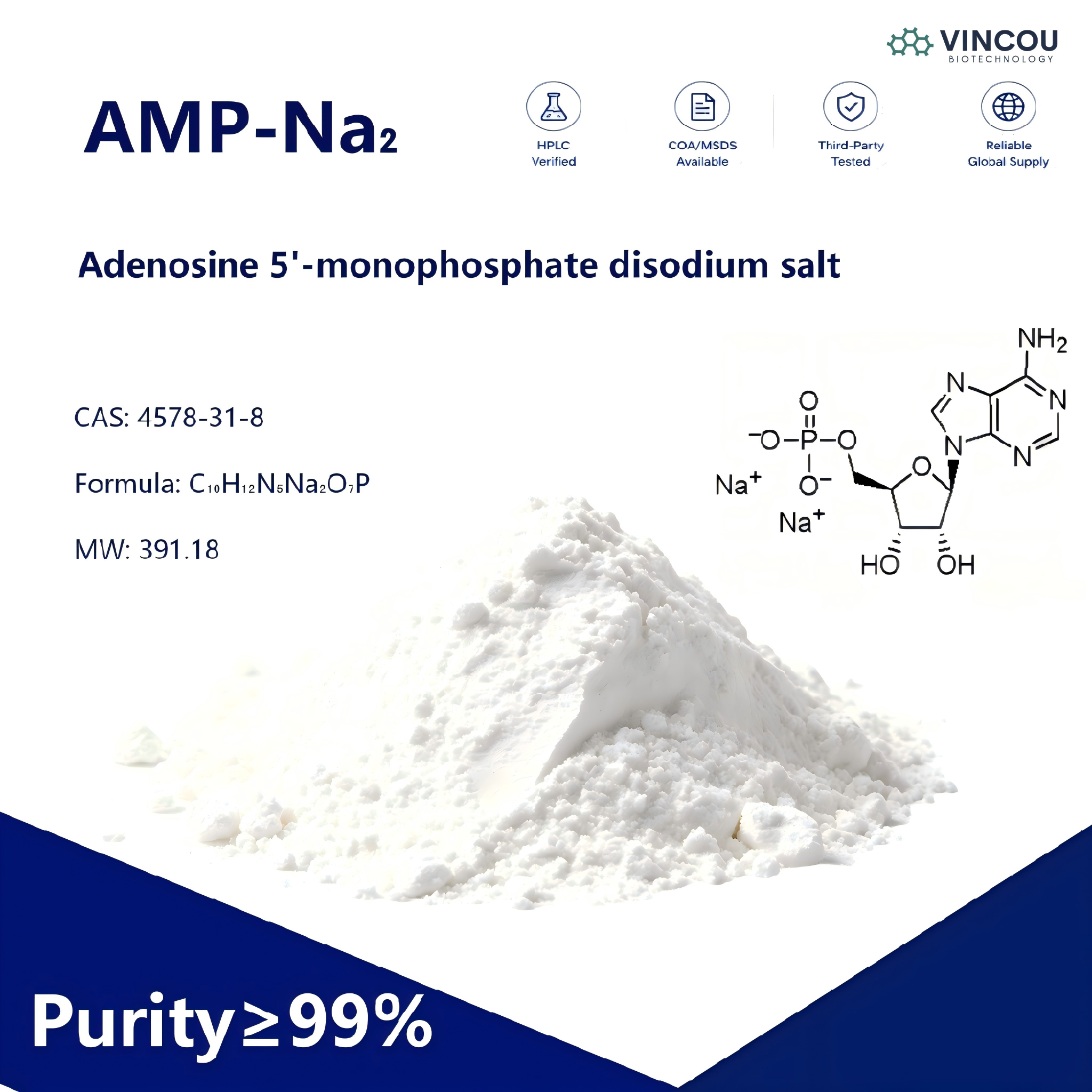
Our factory supplies high purity Adenosine 5′-Monophosphate Disodium Salt (5′-AMP Disodium Salt), a white crystalline nucleotide powder with CAS 4578-31-8. We produce food grade, cosmetic grade and pharmaceutical raw material grade batches with full COA, HPLC purity ≥99%. This widely used nucleotide acts as core intermediate for ATP synthesis, infant formula nutrition fortifier, skin anti-aging raw material and laboratory enzyme substrate. We support bulk 25kg drum wholesale, small trial 1kg foil bag samples, stable stock, custom inspection reports and global door-to-door logistics for B2B manufacturers, labs and food processing factories.

Premium Quality
5′-AMP Disodium Salt Factory Supply
Direct factory-direct manufacturer supply of high-purity Adenosine 5′-Monophosphate Disodium Salt with global shipping and complete B2B documentation.
Product Core Quick-View
Chemical Identity
CAS Number: 4578-31-8
Physical Form: White hygroscopic crystalline powder
Logistics & Bulk Packing
- 1kg vacuum aluminum foil bag
- 25kg fiber drum with PE inner liner
Compliance & Documents
COA
MSDS
HPLC Test Report
Customs Files
MSDS
HPLC Test Report
Customs Files
HPLC Purity Standards By Grade
| Application Grade | HPLC Purity Standard | Quality Status |
|---|---|---|
| Pharma Grade | ≥99.0% | Premium synthesis active raw material |
| Food Grade | ≥98.0% | Compliant infant formula fortifier |
| Reagent / Lab Grade | ≥95.0% | Standard bio-research substrate |
Main Downstream Buyer Groups
We support full commercial sourcing and custom optimization for the following global manufacturing industries:
🏭 Pharma Raw Material Factories
🍼 Infant Formula Manufacturers
🔬 Cosmetic Labs & R&D Studios
🧬 Biological Research Institutions
🚜 Feed Additive Producers
🍼 Infant Formula Manufacturers
🔬 Cosmetic Labs & R&D Studios
🧬 Biological Research Institutions
🚜 Feed Additive Producers
Detailed Information
1. Basic Chemical Identification
- Full English Name: Adenosine 5′-Monophosphate Disodium Salt
- Short Aliases: 5′-AMP-Na2, Adenylic acid disodium salt, AMP disodium
- CAS Registry Number: 4578-31-8
- EINECS Number: 224-961-2
- Molecular Formula (Anhydrous): C10H12N5Na2O7P
- Molecular Weight: 391.19
- MDL Number: MFCD00065023
2. Physical & Chemical Properties
Appearance
White to off-white crystalline powder, odorless, highly hygroscopic
White to off-white crystalline powder, odorless, highly hygroscopic
Solubility
Freely soluble in purified water; slightly soluble in DMSO; insoluble in ethanol, acetone and ether
Freely soluble in purified water; slightly soluble in DMSO; insoluble in ethanol, acetone and ether
Key Specifications
- 1% Aqueous pH: 7.5–8.5 (weak alkaline)
- UV Absorption Peak: 260nm
- Decomposition Temp: 232–235°C
- Specific Rotation: -43±2°
3. Standard Quality Control Index (Factory Inspection Standard)
| Test Item | Pharma Grade | Food Grade | Lab Reagent Grade |
|---|---|---|---|
| HPLC Purity | ≥99.0% | ≥98.0% | ≥95.0% |
| Loss on Drying | ≤2.0% | ≤8.0% | ≤10.0% |
| Lead (Pb) Heavy Metal | ≤10ppm | ≤10ppm | ≤20ppm |
| Arsenic (As) | ≤2ppm | ≤2ppm | ≤5ppm |
| Free Adenosine Residue | ≤0.5% | ≤0.8% | ≤1.2% |
| Free Phosphate | ≤0.3% | ≤0.5% | ≤1.0% |
| Chloride & Sulfate | ≤0.1% | ≤0.15% | ≤0.2% |
| Microbial Limit | Total bacteria ≤100CFU/g, no Salmonella/E.coli | Total bacteria ≤300CFU/g | No strict control |
4. Why Choose Us? Production & Supply Advantages For B2B Buyers
✓ Dual Production Lines Flexibility
Chemical synthetic high-purity pharma grade & yeast fermentation natural food grade supporting flexible batch switching.
Chemical synthetic high-purity pharma grade & yeast fermentation natural food grade supporting flexible batch switching.
✓ Capacity & Stability Guaranteed
Stable raw material supply chain with 12 tons monthly output. No seasonal stock shortage.
Stable raw material supply chain with 12 tons monthly output. No seasonal stock shortage.
✓ Full Qualification & Customization
Independent testing lab providing formal COA for each batch. Customizable purity/moisture parameters based on local industry regulations. Full export documents (MSDS, COA, Packing List, Certificate of Origin, SGS optional).
Independent testing lab providing formal COA for each batch. Customizable purity/moisture parameters based on local industry regulations. Full export documents (MSDS, COA, Packing List, Certificate of Origin, SGS optional).
✓ Flexible MOQ & Tiered Pricing
We support a 1kg trial order for new customers; large bulk orders enjoy industry-competitive tiered discount pricing.
We support a 1kg trial order for new customers; large bulk orders enjoy industry-competitive tiered discount pricing.
5. Storage, Packaging & Transportation Rules
📦 Standard Packaging: 1kg vacuum aluminum foil bag; 25kg fiber drum lined with food-grade PE plastic bag.
❄️ Storage Conditions: Sealed, dry, and dark environment. Long-term storage at -20°C; room temperature storage valid within 6 months with desiccant.
🚚 Transportation Attribute: Classified as Non-dangerous chemical goods. Avoid rain and moisture; strictly separate storage from strong acids and oxidants during transit.
⏳ Shelf Life: 24 months under sealed and recommended storage conditions.
FAQ
General Purchase & Supply FAQ
❓ Can I get free 5′-AMP disodium salt samples for lab testing?
A: Yes, we provide 10g–100g trial samples with the buyer covering the freight cost. The formal bulk order can deduct the sample fee from the total payment. All samples come with a matching batch COA test report.
❓ What is your minimum order quantity of Adenosine 5′-Monophosphate Disodium Salt?
A: Our MOQ is 1kg for small laboratory and cosmetic factory trials. Bulk orders start from a 25kg drum, and larger quantities qualify for a better unit price discount.
❓ How long is your production and delivery lead time after deposit?
A: Stock items ship within 3 working days; customized high-purity batches take 7–10 working days. The sea freight global delivery cycle is 25–40 days based on the destination port.
Quality & Standard Compliance FAQ
❓ Does your food grade 5′-AMP disodium meet international food additive standards?
A: Our food-grade product complies with GB 2760 and FCC IV food chemical specifications, and meets EU food raw material import inspection requirements. Full microbial and heavy metal testing records are attached.
❓ Can you adjust product moisture and purity according to my factory’s formula demand?
A: Yes. Our technical team supports customized technical indicators. Simply send your target inspection standard file; we will adjust the production process and provide a pre-production sample for your confirmation before mass manufacturing.
❓ What documents can you provide for customs clearance and factory audit?
A: Our standard document package includes COA, MSDS, Commercial Invoice, Packing List, and Certificate of Origin. An SGS third-party testing report is available at an extra cost for import customs inspection.
Application & Technical Usage FAQ
❓ What industries commonly purchase Adenosine 5′-Monophosphate Disodium Salt as a raw material?
A: Main downstream buyers cover pharmaceutical intermediate manufacturers, infant formula nutrition factories, anti-aging cosmetic raw material labs, biological research labs, and aquaculture/livestock feed additive producers.
❓ Why is 5′-AMP disodium easily deliquescent, and how should it be stored?
A: The product has strong hygroscopicity caused by its sodium ion structure. After opening the packaging, seal it tightly with a desiccant and store it in a low-humidity, dark warehouse. Aqueous solutions must be stored frozen at -20°C to prevent rapid degradation.
❓ What is the difference between synthetic grade and fermented food grade AMP disodium salt?
A: The Chemical Synthetic Grade achieves an HPLC purity of ≥99%, ideal for pharmaceutical intermediate synthesis. The Yeast Fermented Grade is a natural nucleotide source, mainly applied in infant milk powder and functional food due to its milder impurity profile.
Safety & Logistics FAQ
❓ Is Adenosine 5′-Monophosphate Disodium Salt considered dangerous goods for shipping?
A: No, it is classified as an ordinary non-hazardous chemical. No dangerous goods shipping certificate is required; only moisture-proof packaging reinforcement is needed during transportation.
❓ Are there any toxic risks during raw material production and processing?
A: The solid powder has low biotoxicity. Please wear a mask and gloves during operation to avoid long-term inhalation. Rinse skin and eyes with clean water immediately if direct contact occurs.
Certificate
COA, MSDS, and GMP PDF files are available for download.
Ensure quality compliance for pharmaceutical, biotechnology, and cosmetic applications.
Adenosine 5′-Monophosphate Disodium Salt: Full Buyer Guide For Food Pharma Cosmetic Raw Material Sourcing
Global manufacturers sourcing functional nucleotide raw materials consistently prioritize Adenosine 5′-Monophosphate Disodium Salt, also shortened as 5′-AMP disodium salt, a versatile nucleotide compound with CAS 4578-31-8. Many overseas procurement managers struggle to find reliable factories that balance stable high purity, complete export certification, and flexible bulk supply. As a professional nucleotide raw material manufacturer with over 8 years of export experience, we break down every critical detail B2B buyers need to confirm before placing large orders, covering grade differentiation, downstream application matching, quality inspection standards, storage risks, and bulk purchasing cost control. This guide targets food additive factories, pharmaceutical intermediate workshops, cosmetic R&D labs, and biological research institutions searching for consistent, compliant 5′-AMP disodium salt suppliers.
1. Core Industrial Applications of Adenosine 5′-Monophosphate Disodium Salt For B2B Manufacturers
Pharma Pharmaceutical Intermediate Raw Material Production
Pharma grade 5′-AMP disodium salt with HPLC ≥99% acts as the core precursor for synthesizing ATP, cAMP, adenosine injection, and antiviral nucleoside drugs. Drug manufacturers rely on low free adenosine and phosphate impurities to avoid side reactions during chemical synthesis. Lab research teams also purchase this product as a standard enzyme substrate for AMPK kinase activity testing, nucleotide metabolism cell experiments, and clinical biochemistry detection kits. Most pharma buyers require full heavy metal and microbial testing reports to meet FDA and EP raw material entry rules, which small-scale traders often fail to provide.
Food Infant Formula & Functional Food Nutrition Fortifier
Fermentation-derived food grade Adenosine 5′-Monophosphate Disodium Salt is a recognized breast milk matching nucleotide additive. Infant milk powder factories add controlled doses to boost infant intestinal immunity and reduce diarrhea incidence, while functional beverage and health supplement brands use it to relieve physical fatigue and regulate lipid metabolism. Global food processors prioritize fermented raw materials over chemically synthesized versions for consumer label compliance, and they frequently ask suppliers to provide FCC (Food Chemicals Codex) food grade certification to pass local food safety authority audits. Compound flavor manufacturers also mix 5′-AMP disodium with GMP and IMP disodium to enhance natural umami taste without artificial flavor enhancers.
Cosmetic Anti-Aging Cosmetic Active Ingredient Supply
Cosmetic formulators source low-moisture 5′-AMP disodium powder to create skin repair serums and anti-wrinkle creams. The nucleotide activates cell energy metabolism, speeds up stratum corneum renewal, and reduces mild inflammatory skin irritation. Unlike many single-function cosmetic raw materials, AMP disodium works seamlessly with hyaluronic acid and peptide combinations, so cosmetic factories usually place repeated bulk orders with strict control on water content to prevent raw material degradation during emulsion production. Small cosmetic R&D studios often start with 1kg trial orders before mass formula launch.
Feed Livestock & Aquaculture Feed Additive
Feed manufacturers add food-grade 5′-AMP disodium to young piglet, fry, and shrimp feed to improve juvenile intestinal development and lower farming mortality rates. Compared with expensive immune booster additives, nucleotide raw materials deliver steady cost performance for large-scale aquaculture farms. Feed buyers prioritize low-cost bulk 25kg drum packaging and long shelf-life batches to cut storage and transportation expenses.
2. How To Distinguish Qualified Factory Grade AMP Disodium Salt From Low-Quality Substitutes
Many first-time buyers receive impure AMP disodium with excessive free phosphate or high moisture, which directly ruins their production batches. Three core inspection standards help purchasers avoid unqualified goods, and all three indicators must be listed in the supplier’s COA document before deposit payment:
1. HPLC Purity Matching
Pharmaceutical synthesis requires a minimum of 99% purity, while food and feed production can accept a 98% standard grade.
Pharmaceutical synthesis requires a minimum of 99% purity, while food and feed production can accept a 98% standard grade.
2. Loss on Drying Value
High-hygroscopic raw materials with moisture over 8% will agglomerate during long-distance sea shipping and lose activity.
High-hygroscopic raw materials with moisture over 8% will agglomerate during long-distance sea shipping and lose activity.
3. Impurity Restrictions
Strict verification of impurity limits including free adenosine, heavy metal lead, and arsenic is required for food and medical end products.
Strict verification of impurity limits including free adenosine, heavy metal lead, and arsenic is required for food and medical end products.
⚠️ Industry Alert: Trading companies without self-owned production workshops often blend low-purity AMP powder with other cheap nucleotides to cut costs, leading to unstable product performance after formulation. Professional factory suppliers maintain independent fermentation and chemical synthesis workshops, complete online real-time testing equipment, and full batch traceability records.
3. Key Storage & Transportation Risks All Bulk Buyers Must Control
Adenosine 5′-Monophosphate Disodium Salt’s biggest storage flaw is strong hygroscopicity, a detail many overseas procurement teams overlook during warehouse planning.
- Warehouse Control: After unpacking the 25kg fiber drum, buyers must add desiccant and seal the PE liner tightly. Exposed powder absorbs air moisture rapidly, forming hard lumps. For long-term stock storage over 6 months, warehouses need to maintain humidity below 40% and constant dark conditions.
- Cross-Border Transit: Suppliers must reinforce packaging with waterproof outer cartons to prevent rainwater infiltration at ports. Air freight small trial orders use sealed aluminum foil bags with double desiccant packaging.
- Aqueous Solution Rules: Diluted solutions cannot be stored at room temperature; lab and cosmetic factories need to prepare frozen storage equipment to extend liquid reagent validity up to 6 months at -20°C. For handling safety parameters, please refer to the standard MSDS guidelines.
4. B2B Bulk Sourcing Tips For Cost-Effective Procurement
Experienced global raw material purchasers follow four practical rules to reduce overall procurement costs without sacrificing quality standards:
1
Match Product Grade to Downstream Application: Do not purchase expensive 99% pharma grade raw material for feed or cosmetic production. Food grade 98% purity fully meets these scenarios and cuts unit cost by 12–18%.
2
Consolidate Quarterly Bulk Orders: Monthly small orders generate higher logistics and packaging fees. Combined 1000kg bulk shipments qualify for tiered factory discounts and lower sea freight unit costs.
3
Confirm Full Document List Before Shipment: Pre-check COA, MSDS, and Certificate of Origin to avoid import customs clearance delays and extra detention charges at destination ports.
4
Reserve Pre-Production Samples for Formula Verification: Test 50–100g factory samples with your production formula first to eliminate batch inconsistency risks after large deposit payments.
Our Factory’s Commitment: We provide dedicated technical support for every bulk buyer, including customized indicator adjustment and production formula matching consultation. We also support third-party independent testing (such as SGS) before shipment to eliminate quality disputes after cargo arrival.


